



 Via Bike Pirates:
Join Bike Pirates for a special documentary film night on Friday Oct 16th at 8pm.Contact Bike Pirates here
Showcasing small independent docs directed by Toronto cyclists riding the streets.
Calling out to all Toronto cyclists to bring in their homemade films about riding in Toronto, please submit?
Films will be showed at Bike Pirates, 1292 Bloor Street W. at 8pm
Labels: bike pirates, film festival, Toronto
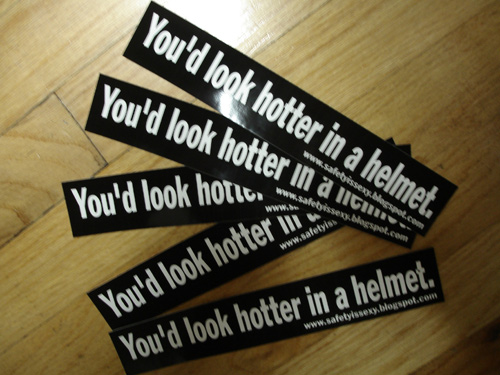
Be it helmets, bike lights, reflective tape and countless other accessories there are an infinite number of ways to improve your safety while on a bike.
Photo via BikeCommuters
Labels: B:C:Clettes, Momentum Magazine, safety

Dusted off from the archives, WolfRuck brings us some vintage footage of first-person cycling through Toronto's 80s streets. The biggest difference: no bike lanes. The same: the red pumps on the cyclist, vintage mountain bike, and the red streetcars.
Labels: 80s Toronto, commute, streetcars

The above photo by Martin Reis is of a bike box that briefly existed at Harbord and Bathurst in 2008. I'm not sure what happened, but I certainly have not seen a bike box at this intersection this year. (Turns out this was a project by the Urban Repair Squad and not the City of Toronto)
 While a previous video explained the NYC bike boxes along one-way streets, this newer video explains how a bike box works on a two-way street:
Labels: Advance Stop Lines, bike box, NYC, Portland, Toronto
A little while ago, I joked about creating a buffalo plaid helmet cover to "Canadianize" the NYC Helmet.


Labels: Buffalo Plaid, fixie

Are you on Twitter?
I am... and you can follow me here: @DuncansCityRide
@tonyhawk thumb down gesture @ bad driver more effective than a middle finger - a bad review instead of a hostile scream.
Labels: bad drivers, gestures, share the road, Tony Hawk, Twitter

Photo caption from Flickr: "This bicycle tag is issued to delivery bicycles who deliver the Toronto Star newspaper. This plate which I have had for a long time was issued in the 1960's or 70's."
However, there's one question that needs to be asked, and one that hasn't been just yet.
What exactly is a bicycle licence or cyclist's license?
There are differences between the two and we need to clarify these first.
A bicycle licence isn't a new idea. These have been around for years. The Flickr account of woody1778a has a collection of bicycle licence plates from Winnipeg, Calgary, Edmonton, Quebec and elsewhere.
A bicycle licence is simply bicycle registration. Cities like Madison, WI, Davis, CA, St. Lake City, UT and Regina, SK all have bicycle licence programs. These are free in some cases and can cost up to $10. Having a bicycle licence in these cities means you have registered your bicycle for identification in the instance it is recovered after theft. It can also be used to identify the owner of the bicycle if they suffer a serious injury. And it also provides city planners with a count of cyclists (or bicycles really) to use when planning infrastructure. Some of the money collected can go towards funding cycling infrastructure, however at such low costs there is often very little money generated for bike lanes or anything else.
In Toronto, the Toronto Police Service already provides free bicycle registration that is not mandatory, but is highly recommended to aid in the recovery of stolen bicycles. There is no registration number provided, although retaining your bicycle's serial number is the same as having a unique registration number as this is used for identification.
On the other hand we have a cyclist's license that would grant the holder permission to use a bicycle.
While my search has certainly not been exhaustive, I have yet to find an example of a cyclist's license in use anywhere in the world. If you know of any, please let me know in the Biking Toronto Forum.
Motorists, boaters and pilots all require a license to operate their vehicles. Licenses are issued after testing and must be renewed after a certain amount of time with the exception of boaters who simply must pass their licensing test once.
Why then, should a cyclist's licensing program be started? And do we even need one at all?
Currently, cyclist's are regulated under the Highway Traffic Act (HTA). On a bicycle you're required to follow all of the rules of the road. Stopping at stop signs and red lights, signaling turns and having appropriate lighting at night are all covered under the HTA and cyclists can be issued fines for these offenses.
However, these charges do not affect the current points system on their driver's licenses, should they have one. The argument here is that by licensing cyclists, you can track their offenses and possibly even revoke their license as we do with motorists.
So then, in Ontario and Toronto cyclists are already regulated. The problem is in enforcement, not regulation. And, enforcement is currently being stepped up, especially in Toronto as thousands of violations are issued each year to cyclists.
Labels: bicycle licence, city council, cyclist's license, debate, Toronto
I'm wondering if I can spice up my commute like this?
Via Bike Commuters
Labels: commuting, style, video
Excellent training video for Chicago Police Officers that could easily be converted for cyclist and driver education in any city... oh, and how about a 3 feet for passing law in Ontario???
Traffic Enforcement for Bicyclist Safety from Chicago Bicycle Program on Vimeo.
Via Streetsblog LA
Discuss this video in the Biking Toronto Forum
Labels: 3 feet to pass, Chicago, safety, share the road, video


And we wear solids on our small bikes:

Sometimes we wear all black (to not be seen "salmoning"):

Or we wear all blue:

And then we also wear some other primary colours:

To be seen we wear our safety vests:

And we sometimes wear clothes that are meant not to be seen:

And sometimes we wear no shirts at all:

And when it's warm, we wear shirts to show off our pregnant bellies:

And we wear skirts and motorcycle helmets:

Or we wear silly animal helmets:

Or we wear boxes:

Or we wear no helmet at all because we have cool hair:

And we wear halter tops when taking our other bike out for a walk:

Or we put on our summery Canadian Tuxedo:

And we carry sparklers in summer dresses:

And play the horn in our sharp vests:

When it rains we put on our bright rain jackets:

And when it snows we simply cover up more:

Or cover up completely:

And we sometimes show that we support Toronto cycling-related charities in our I Bike T.O. T-shirts:

All photos from the BikingToronto Flickr Pool
Labels: bicycles, style, Toronto
From CTV.ca:
Montreal
Cycling is just one of many reasons to visit Montreal, though the city is getting props for its forward-pedalling ways.
The city has more than 500 kilometres worth of bike paths and was recently ranked by ForbesTraveller.com as one of "North America's most bike-friendly cities." And visitors can now rent bicycles for only $5 per day, while they wheel around the city's downtown core.
But according to one cycling expert, Montreal has been making its downtown biking better for some time and has been making path improvements to some of its suburbs.
"From what I know, I think Montreal is in a pretty good position in terms of recent developments, especially in the downtown area," said Jean-Francois Pronovost, executive director of the Velo Quebec Association, when speaking to CTV.ca by telephone from Montreal.
Pronovost points to the addition of a year-round bike lane along Maisonneuve Boulevard that opened up about two years ago. It allows cyclists to travel a bidirectional lane that is separated from other road traffic as they make their way through the downtown area.
Looking forward, Pronovost said Montreal needs to continue to cultivate its cycling culture with more designated bike lanes and paths. Then, he said, it becomes a question of sitting back and watching the bicycles hit the city streets.
According to statistics from Montreal police, 663 cyclists received minor injuries in traffic and road collisions last year. An additional 33 cyclists suffered serious injuries and two others died on Montreal roads in 2008.
Toronto
With nearly a million Toronto residents claiming to be at least part-time cyclists, Canada's largest city has taken strides to make cycling better.
There are more bike lanes than in the past, Toronto has opened the first of several planned public bicycle stations and Mayor David Miller has said it is the city's goal to see Torontonians making twice as many bicycling trips as they do today.
And the city's efforts have been noticed.
"Toronto has done a lot to try to become a lot more bicycle-friendly," Greg Mathieu, the head of the Canadian Cycling Association, said in a phone interview earlier this week.
But the system is far from perfect. Toronto bike lanes often empty into very busy streets and there is a perception that cyclists and motorists are at odds with one another.
"It's always the battle, it would seem," Mathieu said.
So far, Toronto police have responded to more than 600 collisions involving cyclists since the start of the year, compared to 34,600 involving cars.
Ottawa
Bicycles are a common site in Canada's capital city, during the warmer months of the year.
You can see them gliding along the lengthy Capital Pathway network, which has more than 180 kilometres worth of paved bike lanes that wind along the city's public parks, museums, rivers and other attractions.
But Ottawa still isn't perfect.
The bike paths can't get you everywhere you want to go and city bike lanes are not available on all major streets, says Michael Powell, a cyclist who contributes to the Cycling in Ottawa blog.
And while Ottawans generally enjoy a relatively good relationship with other vehicles on city roads, Powell said that there are places where the infrastructure is lacking.
"Once you get up to the suburbs, it's a little more scattershot," Powell said in a recent phone interview.
But he admits that the city has a good long-term plan in place for city cycling.
According to the City of Ottawa, 262 cyclists were injured in collisions last year, out of a total of 4,115 people who were injured in traffic collision within city limits.
Vancouver
Residents of British Columbia's largest city make an estimated 60,000 trips by bicycle each day, meaning that cycling safety is a priority issue in Vancouver.
The city says it has doubled its bicycle network over the past decade and Vancouver has identified cycling as its fastest-growing form of transportation.
The newest development in Vancouver's cycling scene is the addition of a walled-off cycling lane on the Burrard Street Bridge -- a packed downtown passage that sees as many as 8,000 to 9,000 cyclists, pedestrians and drivers cross it each hour during peak times.
In May, Vancouver's city council voted to convert one lane of the bridge solely for bicycle use over an indeterminate trial period. The goal was to see if the bridge could be made safer for pedestrians while keeping traffic flowing.
The project was the brainchild of Mayor Gregor Robertson, a life-long cyclist who had long held misgivings about the busy bridge.
"I've been riding this bridge all of my life, and that's the first time I've really felt safe crossing it on my bike," he told CTV British Columbia after trying the bike lane for the first time in July.
So far, the project appears to have been a success.
Earlier this week, Robertson issued a pres release saying that 25 per cent more cyclists were making use of the Burrard Bridge than before the bike lane became operational.
Labels: bike lanes, Canada, commuting, CTV, Cycling, infrastructure, News, Toronto
When you think of mountain biking, Toronto is rarely one of the major destinations that comes to mind. I mean, really, mountains in Toronto?


Labels: Crothers Woods, dirt jumps, Don Valley, mountain biking, Toronto

Do you commute daily to work by bicycle in Toronto? Do you ride the Don Valley trails with your family on the weekends? Do you love your bicycle and biking the streets of Toronto? And, are you looking for a way to support cycling initiatives in Toronto?
* Bikes without Borders
Bikes Without Borders serves marginalized communities in both the developing and developed worlds where bikes and bike-related solutions can have a significant, positive impact on community development.
* Toronto Coalition for Active Transportation
The Toronto Coalition for Active Transportation (TCAT) was formed in 2006 to give a unified voice to the many groups working for a better cycling and pedestrian environment in Toronto. The TCAT plan for active transportation emerged out of consultation with environmental, health and transportation groups from across Toronto. The result is a practical yet visionary plan for how Toronto City Council can make active transportation a central part of transportation planning.
* TrailBlazers Tandem Cycling Club
The TrailBlazers Tandem Cycling Club provides people who have limited or no vision the opportunity to experience cycling with our sighted volunteers, using tandems.

Labels: ibiketo.org, stuff, support, Toronto
Warning; this is a very disturbing video...
More on this video and the event in the Biking Toronto Forum

I've stopped reading the comments from readers on almost all news articles on the topic of cycling in Toronto.
A police officer on his bike chased down and fined the first-year U of T student yesterday on St. George St. after he ran a red light on his bicycle. The visibly upset student, who wouldn't give his name, said he was from China and didn't know the rules.
Cycling organizations should also speak out more against their "radical" members, Burrows added."We know that 99.9% of drivers will stop at a red light. We don't know that with cyclists," he said.
I ask again, why do some cyclists in Toronto break the rules of the road?
1) Safety
How can running a red light increase safety? How does not coming to a complete stop at a stop sign increase anyone's safety?
It is unfair and unreasonable to assume that just because I'm on a bicycle, I have some sort of twisted death wish. If I really wanted to die in Toronto, I'd get in a car. When approaching a red light I know there's going to be a stream of cars piling up behind me. Some of the drivers are going to try and push to get in front of me at the light, the rest are going to push me in the intersection as I'm trying to build speed again. This is why you see so many cyclists in crosswalks, when you're being tailed by monstrous steel machines, you're going to move to where you know they aren't going to go.
Why then, would I run a red light? If the way is clear, running the red gets me through an intersection without impatient drivers riding my ass or trying to squeeze me out of the lane. Once through the intersection, I can now establish my line, so the drivers coming up quickly behind me can react and pass me safely.
Same goes for stop signs. I proceed safely without coming to a full stop and I preserve some momentum and get to continue on in a predictable fashion. And that's what motorists want, isn't it? Predictability.
2) Lack of enforcement
Even Toronto Police Services admits to this. They are lack on enforcing the rules of the road when it comes to cyclists. And, we can all see why. Cyclists very, very, very rarely kill people. Cyclists, even with our growing numbers, are still a minority. And what's more dangerous? The guy in his car eating a breakfast sandwich and speeding along a side street, or a cyclist, going less than 20 km/h, who doesn't fully stop at a stop sign? It's not like either of these are rare occurrences on our roads.
3) Laziness
Even though it takes far more physical energy to operate a bicycle vs. a car, cyclists can be and are often lazy. We want to get where we're going as fast as possible.
Motorists, doesn't that sound familiar? Isn't that why we have drive-thru banks and coffee shops? Isn't that why there are HOV lanes on highways? Isn't that why your car can go 160 km/h when you legally should never reach speeds greater than 100 km/h, and much lower in our city?
We go the wrong way on streets because it is simply easier than trying to get into a turning lane, then wait for oncoming traffic while watching behind us for anyone who doesn't see us and then get honked at because we turn too slow. We go the wrong way because our destination is on the side of the street we're on and we don't want to deal with street car tracks. The reasons are numerous, even if they aren't in the name of safety and following the rules.
So, the next time you see a cyclist breaking the rules, ask yourself why they are behaving in this manner. There is always a reason for a cyclists behaviour. Cyclists aren't always making the right choices, and we do need to address not only the problem action, but also the reason behind why this action was made.
What do you think of the rules of the road and why cyclists break them in Toronto? Discuss this in the Biking Toronto Forum
Photo by ammiiirrr posted to Flickr
Labels: bike lanes, Highway Traffic Act, infrastructure, Police, rules of the road, safety, Toronto