



While waiting for the TTC last night at Dufferin and Bloor I watched several cyclists pedal by. Mostly, they were men. And mostly they were wearing cycling tights, and bright yellow cycling jackets, and thick gloves and goggles or glasses.
Video via Let's Go Ride a Bike
How do you dress for winter cycling in Toronto? Share your tips in the BikingToronto Forum
Labels: clothing, commuting, Cycling, Toronto winters, wool
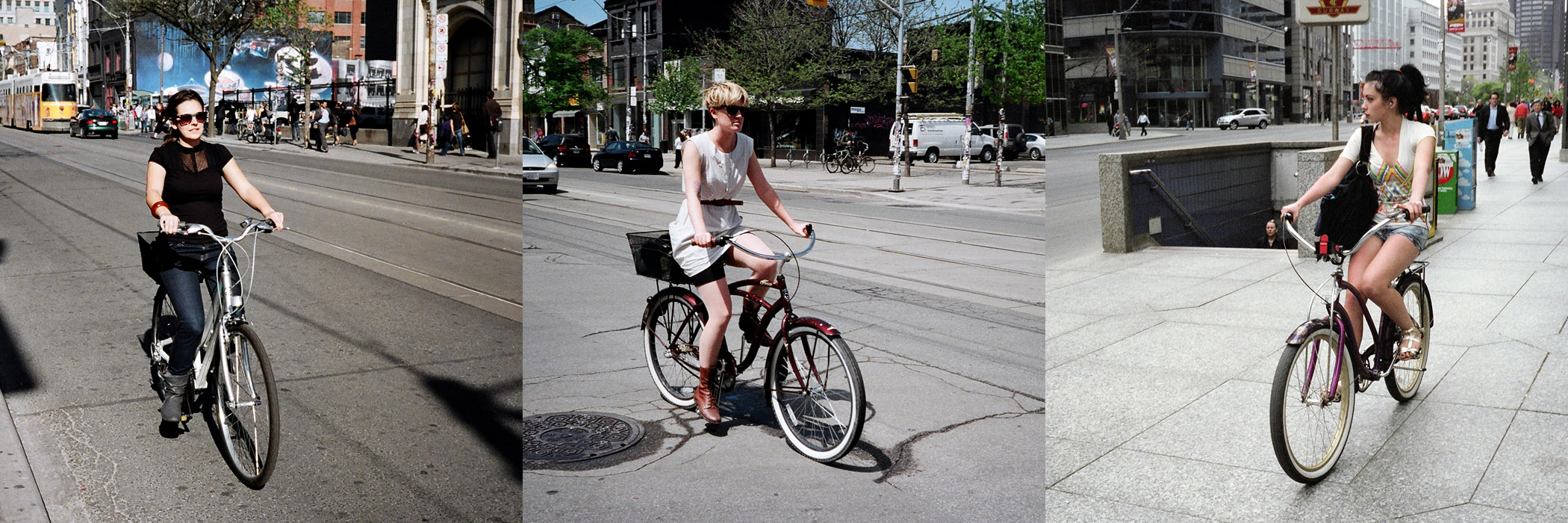
What's stopping teenage girls from riding bikes?
Campaigns to get women cycling seem to focus on how to look good over other concerns. Is this really all girls care about?Posted by Sarah Phillips
Teenage girls don't ride bikes. Or so says the Darlington Media Group, who have set about trying to rectify the problem with a campaign to get young women cycling.
Several years ago, the National Children's Bureau published research that revealed that on average, boys cycle 138 miles a year and girls only 24 miles. This still rings true. Christie Rae, 16, from Newcastle told me: "I do have a bike, but I don't really use it. Only sometimes in the summer when my friends and I cycle round to see each other. I don't know many girls that do, actually."
Darlington's project began with the production of a documentary called Beauty and the Bike, chronicling a trip made by a group of teenage girls to Bremen in Germany, where they met their cycling-loving peers and found out about the joys of the open road. It all sounds slightly twee, but addresses the important issue that girls tend to get to a certain age and it's no longer the done thing to get about by bike.
I have every admiration for such attempt to get women enjoying the numerous benefits of cycling, but what is frustrating is the focus on appearance that is often so integral to said schemes. Aside from the title, BATB, which incidentally has been used for a similar scheme in the past, Darlington's site makes it clear they are keen to address the important issue of remaining fashionable while cycling. But as I recall, it was an overprotective mother that stopped me from spending too much time around the bike sheds in my teenage years, rather than any personal concerns over the way I looked.
Another offender is the site Bike Belles, run by the otherwise excellent charity Sustrans, which encourages women of all ages to take up cycling. One helpful section dedicated to beauty tips provides such gems as: "Use waterproof mascara when it's raining on your bike, and take a powder compact for a quick refresher on arrival." Admittedly, I write as someone who occasionally arrives at the office sporting a minor oil slick on my face, but I sincerely doubt that women are so image conscious that this is what is stopping them. As many a female cyclist will confirm, it is more hassle than it's worth looking attractive while travelling by bike.
Aside from fashion tips, the beauty bikers and belles both voice concerns over the lack of decent cycle lanes and safety issues that make our roads a wholly unappealing prospect. Those two are serious issues that would put inexperienced riders off, and are much more worthy of a campaign to get people, regardless of gender, on their bikes.
Labels: commuting, fashion, Guardian, helmets, infrastructure, safety, UK, women

Congestion. Downtown Toronto is congested with pollution-emitting vehicles. Yet, pockets of our city also have other forms of congestion, ones we certainly aren't as worried about.
Et tu, Toronto? Traffic a problem Caesar couldn't solve
Options up for consideration at Transportation Futures conference include toll roads monitored by GPS and High Occupancy toll lanes
Anna Mehler Paperny
More than 2,000 years ago, Julius Caesar is said to have gotten so fed up with traffic congestion in ancient Rome that he banned all transport vehicles from the city during the day.
The ensuing nocturnal clatter resulting from this “war on the cart,” as Romans took their commute to the city's narrow nighttime streets, caused mass insomnia and apparently drove Juvenal mad.
Traffic congestion is far from a new problem, or one exclusive to Canada's largest city, whose overcrowded roads, according to the Organization for Economic Co-operation and Development, are costing the Canadian economy $3.3-billion a year. Across North America, individual vehicle trips have grown at a rate far outpacing either population growth or new transportation infrastructure for years. When Toronto Mayor David Miller was first elected in 2003, he made addressing the city's jam-packed roadways a priority – and was the target of a political drubbing for suggesting tolls might be the answer.
This morning in downtown's Metropolitan Hotel, Transport Futures, a non-partisan think-tank, will host a conference to discuss the options open to planners seeking respite from clogged transportation arteries.
This meeting comes on the heels of an Organization for Economic Co-operation and Development report released this week that found congestion in Canada's most populous city costs the country an estimated $3.3-billion annually, and a gauntlet thrown down by the Toronto Board of Trade challenging the city's mayoral candidates to come up with innovative solutions.
Here are some of the options up for consideration.
The Phantom Tollbooth
Nineteenth-century Torontonians had to stop and pay a fee at toll booths on Kingston Road, and although the endangered species of traditional toll booth is almost extinct, it's still in common on bridges.
In the meantime, far more fancy incarnations are taking the “free” out of freeway: Toll gates that could be installed on highways around the Toronto area could charge drivers based on anything from their mileage and driving time to their carbon footprints.
Taking the high-tech route
The congestion-pricing system of the future operates like a souped-up Global Positioning System. It's used in Singapore, the planet's dean of congestion pricing – the island city-state has been fighting clogged roads since 1975. The latest technology involves transponders installed in each vehicle, and charges drivers based on where they drive, what time of day and for how long. Singapore adjusts its prices depending on how crowded roads are, charging more as vehicles' average speed slows to a traffic-clogged crawl and dropping it when space frees up.
London and Stockholm, both cities with a clearly demarcated downtown core, charge drivers each time they enter the inner city. While London has a flat rate, the peninsular Swedish capital changes its fees based on time of day – a far superior, nuanced strategy in targeting congestion, argues Bern Grush. Mr. Grush is chief scientist at Skymeter, a Toronto-based company that researches and manufactures this radio-frequency identification for vehicles.
But a toll strategy that cordons off Toronto's downtown could be a hard political and logistic sell. An ambitious alternative that just received legislative approval in the Netherlands would cover a wide swath – conceivably as much as the entire province of Ontario – so vehicles would be tracked and automatically billed varying prices wherever they went.
High-Occupancy Toll lanes
One more reason to bring your spouse, child or cubicle-buddy along for the ride. Within the next 25 years, Ontario has plans to create 450 kilometres of High-Occupancy Vehicle (HOV) lanes that would be reserved for multi-passenger cars. But many jurisdictions are turning to High-Occupancy Toll lanes and letting solo drivers use them – for a price. Shortly after HOT lanes were set up on a bottleneck stretch of California highway between Orange County and Riverside County, almost half the drivers opted to use the less crowded toll lanes.
Parking
Simple equation: You're less likely to drive your car to work if there's nowhere to put it once you get there. In many jurisdictions there's a growing push to lessen the number of parking spots available, or at least to make them more expensive. Copenhagen has been doing just this – taking away a few parking spots every year in an urban-planning version of musical chairs – for decades, says University of Toronto geography professor Paul Hess, and it seems to be working on the congestion-fighting front. That might not go over so well in Hogtown, however, where business owners and landlords are still required to provide a minimum number of parking spots in their establishments.
Transit and cycling
All those wallet-protecting commuters will have to go somewhere. Although some road space is expected to be freed up when drivers take less clogged routes or make their drive in off-hours, improved transit and cycling infrastructure is a vital part of the equation, says University of Toronto urban planning professor Paul Hess: The city needs to act aggressively to beef up its “skeletal” transit system and make the city safe and attractive for would-be cycling commuters – something it has taken other cities decades to accomplish.
But, Prof. Hess noted, “all successful cities face congestion issues.
“If you don't have congestion, then you're actually in trouble because people aren't moving around wanting to do things.”
Labels: commuting, congestion, Globe and Mail, GPS, parking, tolls, Toronto

Is "bikephopia" a spelling mistake? Or is it a strange mish-mash word meaning a city where it is fear-inducing to bike in? Sort of a bicycle negative of utopia...
From The Toronto Star:
How to conquer bikephopia
A new study suggests women fear cycling in infrastrucutre-poor cities like Toronto. I'm trying to get over it
My bike is going to kill me. That was all I could think about as I rolled the thing out of my apartment and made those initial awkward pedal pushes in my first ride around downtown Toronto.
But gliding along Queen St., with no angry cars honking or getting too close to my wheels, I figured I might actually get home alive. If I could just remember the road rules.
Hand signal directional changes. Turn left on left lanes only, or get off the bike and cross the intersection like a pedestrian. If you're changing lanes near streetcar tracks, approach them at a sharp angle so your tires don't get caught in them. And for God's sake, don't pass cars on their right-hand side at stoplights.
You know the saying that you never forget how to ride a bike? Apparently I had. Or was too scared to remember. Either way, I'm not the only one. Studies from Australia and the U.S. identify me with a demographic researchers insist is key to promoting urban cycling: women.
Jan Garrard, senior public health lecturer at Deakin University in Melbourne, Australia, calls us an "indicator species." Women are more likely than men to avoid cycling because they see it as dangerous. The extent to which women hop on their two-wheelers, or fail to do so, is a good indication of how developed a city's cycling infrastructure is – how safe it is for biking, how accessible and extensive its bike lanes are.
Women in North America largely don't ride bikes. In areas where they do, such as Europe, there are more cyclists on the road overall.
John Pucher, a professor of planning and public policy at Rutgers University in New Jersey, has studied this trend for over 12 years. He found that in Denmark, where 18 per cent of all commutes are by bike, women make up 45 per cent of cyclists on the road. In the Netherlands, where women cyclists are in a slight majority at 55 per cent, cycling takes up nearly a third of all commuting trips.
We Canadians, however, aren't doing so well at a 30 per cent bike share for women, and maybe a 2 per cent commute share for bikes. (The trend is similar in the U.S and Australia.) In Toronto, just 1.7 per cent of the population rode to work in 2006 – just 35 per cent of them female. But we're not the worst city, laughs Pucher. "In Dallas, Texas, 95 per cent of bicyclists are men. Which is disgusting!"
Garrard, meanwhile, explores the psychology behind the numbers – why most women refrain from riding in the first place. She surveyed Melbourne's cycling population by asking what situations kept them from the road.
"For just about every constraint we included in our item list," she says, "women were more likely to say it was a constraint. And these things included traffic conditions, weather, lack of time."
Sounds familiar to me. Though I'd have added fear of my face in the pavement.
A larger number of women also indicated they preferred off-road routes, or paths separate from cars. Last month, Scientific American reported on a Portland, Ore. study that coincides with this, having tracked Portland cycling commutes by GPS. When given the choice, women were more likely to take longer routes to a destination if it meant using a car-separate path.
Which is something cycling advocates in Toronto would argue we don't have enough of. Most are intended for recreational use – not a lot of help if you're trying to get to work, which is largely why I wanted to cycle in the first place.
Pucher points out that the idea isn't to paint the non-cycling majority of women as timid creatures, and that other bike minorities, children and seniors, are also important in gauging a city's bikeability.
"I'm pretty risk-averse myself," he says. "I think anyone who is concerned with safety is going to want some kind of facilities that address those concerns."
There are bike shops in Toronto that try to, by offering women-only programs that teach bicycle repair and construction and traffic laws.
Sherri Byer, co-ordinator at the Community Bicycling Network on Queen St. W., finds she still gets condescended to in unfamiliar cycling shops, even though she's been fixing bikes for eight years.
"I think that's why Wenches with Wrenches is so popular," Byer says of CBN's four-week program, which aims to provide women with a non-competitive learning space. "I kept thinking the market for it would dry up for it, but it's not."
I figured the Sunday sessions for women and transgendered people at Bike Pirates, a cycling co-op on Bloor and Lansdowne, was a good place to start. If I did the work they would supply me with the help, space and tools to build a bike of my own.
And as Lisa McLean, a Sunday volunteer, points out, there's a certain confidence that comes from knowing how your bike works.
That may not stop me from slamming into the open door of a parked car, I think to myself as McLean shows me how to install ball bearings into a stem. But at least I can fix my bike afterwards.
Besides, I can't imagine any of the women working at Bike Pirates fitting into the description of risk-averse or road-shy. With any luck (and a lot more riding), hopefully I will eventually count myself among them.
Labels: commuting, infrastructure, safety, Toronto, Toronto Star, women
The Toronto Mountain Equipment Co-op store is known for many things. The massive climbing wall, the green roof and the overwhelming array of backpacks. Now, they can add an expanded bicycle section that includes a brand of bikes.


Labels: bikes, commuting, cyclocross, mountain biking, mountain equipment co-op, video

Labels: commuting, safety, the struggle, Toronto, Toronto winters
I'm wondering if I can spice up my commute like this?
Via Bike Commuters
Labels: commuting, style, video
From CTV.ca:
Montreal
Cycling is just one of many reasons to visit Montreal, though the city is getting props for its forward-pedalling ways.
The city has more than 500 kilometres worth of bike paths and was recently ranked by ForbesTraveller.com as one of "North America's most bike-friendly cities." And visitors can now rent bicycles for only $5 per day, while they wheel around the city's downtown core.
But according to one cycling expert, Montreal has been making its downtown biking better for some time and has been making path improvements to some of its suburbs.
"From what I know, I think Montreal is in a pretty good position in terms of recent developments, especially in the downtown area," said Jean-Francois Pronovost, executive director of the Velo Quebec Association, when speaking to CTV.ca by telephone from Montreal.
Pronovost points to the addition of a year-round bike lane along Maisonneuve Boulevard that opened up about two years ago. It allows cyclists to travel a bidirectional lane that is separated from other road traffic as they make their way through the downtown area.
Looking forward, Pronovost said Montreal needs to continue to cultivate its cycling culture with more designated bike lanes and paths. Then, he said, it becomes a question of sitting back and watching the bicycles hit the city streets.
According to statistics from Montreal police, 663 cyclists received minor injuries in traffic and road collisions last year. An additional 33 cyclists suffered serious injuries and two others died on Montreal roads in 2008.
Toronto
With nearly a million Toronto residents claiming to be at least part-time cyclists, Canada's largest city has taken strides to make cycling better.
There are more bike lanes than in the past, Toronto has opened the first of several planned public bicycle stations and Mayor David Miller has said it is the city's goal to see Torontonians making twice as many bicycling trips as they do today.
And the city's efforts have been noticed.
"Toronto has done a lot to try to become a lot more bicycle-friendly," Greg Mathieu, the head of the Canadian Cycling Association, said in a phone interview earlier this week.
But the system is far from perfect. Toronto bike lanes often empty into very busy streets and there is a perception that cyclists and motorists are at odds with one another.
"It's always the battle, it would seem," Mathieu said.
So far, Toronto police have responded to more than 600 collisions involving cyclists since the start of the year, compared to 34,600 involving cars.
Ottawa
Bicycles are a common site in Canada's capital city, during the warmer months of the year.
You can see them gliding along the lengthy Capital Pathway network, which has more than 180 kilometres worth of paved bike lanes that wind along the city's public parks, museums, rivers and other attractions.
But Ottawa still isn't perfect.
The bike paths can't get you everywhere you want to go and city bike lanes are not available on all major streets, says Michael Powell, a cyclist who contributes to the Cycling in Ottawa blog.
And while Ottawans generally enjoy a relatively good relationship with other vehicles on city roads, Powell said that there are places where the infrastructure is lacking.
"Once you get up to the suburbs, it's a little more scattershot," Powell said in a recent phone interview.
But he admits that the city has a good long-term plan in place for city cycling.
According to the City of Ottawa, 262 cyclists were injured in collisions last year, out of a total of 4,115 people who were injured in traffic collision within city limits.
Vancouver
Residents of British Columbia's largest city make an estimated 60,000 trips by bicycle each day, meaning that cycling safety is a priority issue in Vancouver.
The city says it has doubled its bicycle network over the past decade and Vancouver has identified cycling as its fastest-growing form of transportation.
The newest development in Vancouver's cycling scene is the addition of a walled-off cycling lane on the Burrard Street Bridge -- a packed downtown passage that sees as many as 8,000 to 9,000 cyclists, pedestrians and drivers cross it each hour during peak times.
In May, Vancouver's city council voted to convert one lane of the bridge solely for bicycle use over an indeterminate trial period. The goal was to see if the bridge could be made safer for pedestrians while keeping traffic flowing.
The project was the brainchild of Mayor Gregor Robertson, a life-long cyclist who had long held misgivings about the busy bridge.
"I've been riding this bridge all of my life, and that's the first time I've really felt safe crossing it on my bike," he told CTV British Columbia after trying the bike lane for the first time in July.
So far, the project appears to have been a success.
Earlier this week, Robertson issued a pres release saying that 25 per cent more cyclists were making use of the Burrard Bridge than before the bike lane became operational.
Labels: bike lanes, Canada, commuting, CTV, Cycling, infrastructure, News, Toronto

Before I gave up my car I can remember thinking to myself, "Without a car, how will I carry things?"
How would I carry a 24 case of water home?
How would I carry all of my groceries home?
How would I carry my latest IKEA purchases home?
I soon discovered the answers...
Don't buy water in bottles, you've got a tap.
Don't buy all of your groceries at once, and stop buying heavy frozen junk.
Don't buy more stuff from IKEA, unless you're with a friend with a car.
Just because a bicycle doesn't come with trunk space it doesn't mean that we, as Torontonians, are left unable to take anything with us when we ride. Here then are some of the ways we carry stuff by bicycle in Toronto.
Sometimes we like to keep an eye on our stuff and use a basket mounted up front:

Sometimes we want to see the potholes ahead of us and mount a basket on the back:

Sometimes we like to carry more stuff, and have baskets both front and rear:

There are times where we like to improvise the type of baskets we use:

And then sometimes we fill our baskets with keytars in Accordion City:

To keep our stuff dry we sometimes use panniers that match our helmets:

Sometimes we rent trailers to carry even more stuff:

Sometimes we carry other people on our bikes:

Sometimes we improvise how we carry people on our bikes:

And then we sometimes like to carry our children on our bicycles:

Or we take the whole family on a four-wheeled bike while visiting Toronto Island:

And then sometimes we have a really big family, but we still travel by bike (click for larger version):

How do you carry your stuff on a bicycle in Toronto? Share your tips in the Biking Toronto Forum.
Photos via the Biking Toronto Flickr Pool and photographers in Toronto on Flickr
Labels: bicycles, commuting, stuff, Toronto
A project commissioned by the City of New York has set out to encourage the average commuter to wear a functional, and in my opinion, pretty good looking helmet.
Designed by fuseproject, cyclists can customize the look and function of their helmets by adding and removing visors and full covers depending on the weather.


This looks like something that could really take off outside of NYC. In fact, I'd like to see a more "Canadian" version should they introduce a YYZ line in Toronto as I imagine it should look below...

What do you think of the NYC Helmet? Share your thoughts in the Biking Toronto Forum
Via Greenwala
Labels: commuting, helmets, NYC, safety, Toronto

It's been about 4 years since I first moved to Toronto.
I came here with a car and the intention of furthering my career and learn to survive in the big city. Over the past four years I've established a career, lost a car along the way and learned that survival on the streets of Toronto is achieved in more ways than one.
I really can't say I miss my car. Even when it's raining or snowing or when I have to buy a lot of groceries, I can honestly say I don't miss my old green menace one bit (green as in the colour and not as in some environmentally beneficial quality of my old car, so I guess it was a "green menace" in a few ways).
However, my car (and my time as a motorist) has left me with a few personal habits that I'm trying to kick. When I set out on my bicycle, I have to remind myself that I no longer have to travel like a motorist. I'm no longer confined to the routes that cars and trucks must follow. It's difficult at first, but freeing myself from my "motorist habits" is one of the most liberating aspects of becoming a bicycle commuter or, more simply, a cyclist.
There are some habits I can't give up. Like stopping for red lights, signaling my intentions and not driving the wrong way down one-way streets. Those are good habits that I developed behind the wheel. And I still follow these today.
However, finding the most direct and fastest route to my destination is a habit I'm trying to break. Whether I take the main arterial roads or if I choose to discover a few quiet side streets and paths through parks, the time difference is often negligible.
Toronto's lack of safe and consistent cycling infrastructure provides the opportunity to be more creative with your route. In cities like Amsterdam, cycling infrastructure is so prominent it makes more sense to take the main routes. Side streets in Amsterdam are cobblestone-paved, car-parked, child-playing areas that simply don't offer the opportunities to escape main street mayhem like the park trails and side streets of Toronto.
For example, to get from Davisville to Parkdale I could follow the subway and street car lines. Taking Yonge south to King, and then King west to Parkdale is an option. There's a lot of traffic and a lot of obstacles along the way, but it is direct and a route that the motorist in me would take.
On my bike it's a whole other story. I can cut through the quiet streets of Summerhill, bypassing the traffic throttling barriers to keep motorists from cutting through this area on their way from Yonge to Avenue road (or vice-versa). I can follow the bike lanes down Bedford or wind my way through the quiet streets in the Annex. Further south I can get from Dundas to Queen Street through Trinity Bellwoods Park.
Sure, I've taken a few wrong turns, but these never end in disaster. A wrong turn on a bicycle becomes a chance for discovery. New routes are always possible by bicycle, and rarely will they be blocked by rush hour traffic.
In Toronto, surviving the city streets on a bicycle means developing the habit of seeing possible connections between our side streets and park trails and the places we want to go.
Have you made a few "short cut" discoveries in your travels through Toronto? You can share them in the Biking Toronto Forum.
Photo via the_lake_effect's Flickr
Labels: bike lanes, commuting, infrastructure, safety, Toronto

Recently, a cyclist in Brisbane put together a fun cartoon to compare the time, effort and money spent on commuting by bicycle versus bus.
After recording times he discovers there is little difference in the time taken cycling versus taking the bus. He saves more than $600.00 a year on bus fare. And he gains the fitness of cycling 2,100 km.
Now, without the cartoon (which makes his version far more readable) I want to compare my own commute in this way.
Here's the details of my commute:
I live at Yonge and Davisville in Toronto.
I work just south of Canada's Wonderland in Vaughan.
That's a distance of 23.3 km (according to Google maps tracing my bike route)
To get to work by TTC I have to take the subway from Davisville station to Finch station, transfer to the Steeles bus, and then transfer again to the Jane bus.
I can do this by spending $47 per week on a GTA pass, or by forking over $9 a day should I choose not to buy the pass and pay as I go.
Since I have yet to bike to work in the winter, I'll take 20 summer weeks as my example.
My average bus commute is typically 1 hour and 30 mins each way. I commute to work 4 days a week.
That's 12 hours on transit each week. 240 hours over 20 weeks spent sitting on a bus or train. And, should I buy a GTA pass, this will cost me $940.00
240 hours and $940.00!
Since I started biking in to work I tend to average 1 hour and 10 mins each way. But, by the time I get home I need a shower. So, tack on another 10 mins showering and another 10 minutes changing at work (morning and afternoon combined) and my bus and bicycle commute times balance out.
However, my bicycle cost me just under $600. So, right off the bat I'm saving $340 this year alone. And by cycling 23.3 km, each way, I gain the physical fitness benefits of cycling 3,728 km over 20 weeks.
So far so good. But, let's look at this a little further. My transit route by bus and train is relatively safe. The TTC isn't known for losing passengers on a regular basis, so I can assume that aside from not getting any physical activity, my health will remain as is while taking the bus (the odd cold aside).
On my bicycle, it is a whole other game. My route takes me along major arterial routes for the majority of my trip. These routes have posted speed limits of 60 and 70 km/h. On long stretches between stop lights it is not uncommon for motorists to greatly exceed these postings. There are no bike lanes and there is barely enough room in the existing lanes to fit a mid-sized car and my bicycle safely. So, when the pickup trucks, cube vans, dump trucks, garbage trucks and transports try to share a lane with me, well my life flashes before my eyes.
My safety is greatly reduced by taking my bicycle. So, is the trade off worth it? My safety on the bus without any health benefits or the health benefits gained by placing myself in countless dangerous situations a day?
I keep riding, so I'm certainly not turned off by the dangers. That story could change any day though, but I'm hoping it won't.
Share your own bicycle and bus commuting stories in the Biking Toronto Forum.
Bicycle v Bus in Brisbane via Copenhagenize
Photo from flickr user gbalogh
Labels: commuting, infrastructure, safety, Toronto

As with most of my trips to new bike lanes in Toronto, I approached the new Simcoe Street underpass on a day when no one was around.
Prior to completion, an article in the National Post from October, 2008, makes no mention of cyclists or bike lanes. But really, who is thinking about cycling at the beginning of winter? The article addresses the ability of condo residents to walk to work or quickly access trains using the underpass and, as councillor Adam Vaughan stated:
“The biggest impediment to get people down to the waterfront is ... the [lack of] north-south connections, especially ones that are pedestrian-friendly,” Mr. Vaughan said. “It gives that possibility of accidentally ending up at the waterfront.”Now that construction is finished, the addition of bike lanes here provide another option aside from driving, walking or taking transit through this area.
On a Saturday just before noon I spent about 20 minutes at this underpass. In that time I counted 3 cyclists, 2 tour buses and 1 pickup truck. Of course, this underpass was built to allow the residents of condos in the area to walk faster (or drive) to work above Front street. However, the added bonus of helping people access the waterfront seems to have gone unnoticed in the first few days that this section has been open.
Heading south, the bike lane starts on the south side of Front Street and ends at Bremner Boulevard. Under the bridge the lane runs along a retaining wall and in the middle of 4 lanes for motorists there is a median.
Personally, I do not like cycling under (or over) bridges in Toronto. Heading downhill at underpasses results in drivers speeding and the transition from light to dark can often make visibility a huge issue. Bike lanes here do address that problem and help position motorists prior to going under the bridge, but is it enough?

The retaining wall here makes me worry. Why protect pedestrians and the support beams and not cyclists? Why not place the retaining wall so that it separates cyclists and pedestrians from motorists? In the mornings motorists traveling along here may be familiar with the area. But, with the Air Canada Centre, Harbourfront and the Rogers Centre attracting motorists unfamiliar with the area, the potential for collisions between motorists and cyclists certainly must increase.
The bike lanes on the Simcoe Street underpass are a start, but will they ever continue and create a safe passage from the condos and waterfront to downtown?
 I'd like to hear from commuters in the area? Is this bike lane a safe addition? Talk about the Simcoe Street underpass in the Biking Toronto Forum
Labels: bike lanes, commuting, infrastructure, safety, Toronto
There's a new mixed-use path down along the waterfront.
Only, it doesn't go along the water. Ontario Place has claimed that stretch of land for parking.
Replacing a cumbersome diversion through a parking lot and past line ups of tourists, the Martin Goodman Trail now runs parallel to Lake Shore Boulevard and since it's opening on July 31, 2009, has already brought about a concern for safety.
Over the long weekend I took a trip down the new path to see what all the fuss was about. Cycling west from Harbourfront along Queen's Quay was jammed with cars, transit and bikes, reaching the Martin Goodman trail feels like a serene stretch of calm in comparison.
After looping around the Inukshuk at the beginning of the extension, I meet with the first of 3 crossings. Lake Shore Boulevard is quiet late in the afternoon today, the only traffic here is heading home and not turning in to Ontario Place. So, I don't get to see the mayhem of motorists turning left and taking out cyclists. Although I can certainly see how this could happen.
 In the photo above you can see the bicycle signal, the pedestrian signal and two separate paths across the intersection for each. The gates placed just before where the path meets the road do a decent job of slowing bicycle traffic and alerting users to the coming hazard of an intersection.
Of course, this doesn't make for a continuous commute, but for the weekend warrior it's a way of herding the crowds that will accumulate here on red lights.
The signals change quickly, and I believe wait times are less than 30 seconds from what I can tell.

Once across the intersection I am greeted by this sign:

"AUTHORIZED VEHICLES ONLY" Really? That's the best you could do? This sounds so intimidating. Is my bicycle authorized? What are the other authorized vehicles? I thought this was a mixed-use path, not a passage for vehicles of any sort.
Under the assumption that I have full authorization, I continue along the path. I encounter mostly joggers, rollerbladers and cyclists. The roadies won't like the slow pace here and I expect to see a lot of "scorchers" burning around everyone. But there is a good amount of space and I don't feel I have to ride in the grass to avoid getting run over by faster users.
And just look at how everyone is getting along. On a quiet day no one seems upset after crossing at the parking lot entrances.
 While not perfect, the crossings are built to acknowledge safety concerns by slowing traffic along the path. Unfortunately, I neglect to see any notice to drivers to yield to cyclists and foot traffic. Although, in Toronto, motorists have the right of way (and they make that claim with force) so it is reasonable to expect problems along this route at much busier times.
As a final thought, I did encounter a strange event. As I was crossing at the second intersection two motorcycle police made a wide u-turn on Lake Shore and turned into the CNE grounds. Another cyclist spotted this as well, and as he approached the intersection he hopped off of his bike and walked it through the green light eying the biker cops the whole time.
Obviously this cyclist wants to follow the rules, only he doesn't know what they are. Why he didn't follow the lead of every other cyclist and ride through the green light is beyond me. Hopefully another friendly cyclist will inform him to stay calm, carry on through the intersection next time.
Oh, and once I was beyond the "crossings of death" I am back along the waterfront where you get to see strange things like this:
 Discuss the Martin Goodman Trail in the Biking Toronto Forum here.
Labels: commuting, infrastructure, Martin Goodman Trail, safety, Toronto

I remember back to when I was preparing to take my G-1 driver's test. I stayed up really late the night before my exam studying the Ontario Driver's Handbook. I treated this little book the same as one of my science or history texts. I looked for the possibility of trick questions and memorized the seemingly countless street signs while also trying to remember all of the rules.
After taking the short eye test and learning how tall I was I realized that the studying I had done was more than a little excessive. The rules of the road and the signs that dictate them are meant to be intuitive. You should be able to recognize the meaning of a sign with a little additional information and for the most part many people seem to be able to do just that.
While biking around Toronto over the past few years it is a pleasure to see more and more cycling-related signs and painted symbols along our city streets. But, are they enough?
The photo at the top of this page is a "sharrow" painted on Wellesley just west of Yonge and leads to a bike lane that is just beyond a delivery drop-off area.
I personally like sharrows and I believe they should be on most roads in the city. Sharrows inform cyclists that they are on a road with shared traffic. There are no exclusions to the rules and no segregation, to get along you have to go with the flow and you have to follow the rules. The chevrons point the way and even seem to demand that you notice them.
But, unlike many of the cycling-related signs on Toronto streets, sharrows are for both cyclists and motorists.
For motorists, sharrows ask that you give room to cyclists, that you must be aware of their presence and tell you to share the space you're driving in.
While I appreciate bike lanes, and certainly want to see more of them in the city, I don't feel they present a consistent message to the motorists and cyclists on Toronto's streets. A bike lane can be perceived as something separate, something that has been "taken" from motorists and something many drivers feel they need to take back (or so it seems if you've been following the bike lane development along Annette and Dupont).
I find myself getting a little too comfortable in bike lanes, assuming that since I'm in my dedicated cycling space I'll be safe from "door prizes" and unsignaled right turns. This false sense of security doesn't promote safe cycling as much as I believe sharrows can.
On a recent trip to Vancouver Island I noticed that in many areas there is this focus on shared space. I often came across this sign:
 It's a simple sign. The graphic is clear, and the added instruction below leaves no room for misinterpretation.
What are your thoughts on sharrows and bike lanes? Join the discussion in the Biking Toronto Forum.
Labels: bike lanes, commuting, infrastructure, safety, Toronto