




Ok, the headline of this post is a little misleading. I have plenty of complaints about cycling in Toronto. And, if you read BlogTO, you know that there's a list and growing discussion of even more gripes going on there.
But... and this is a big BUT... nothing outweighs the benefits of cycling in Toronto...
We have trails through ravines!
We have a growing bike lane network!
We're busting cops for parking in bike lanes!
We have a cyclists union!
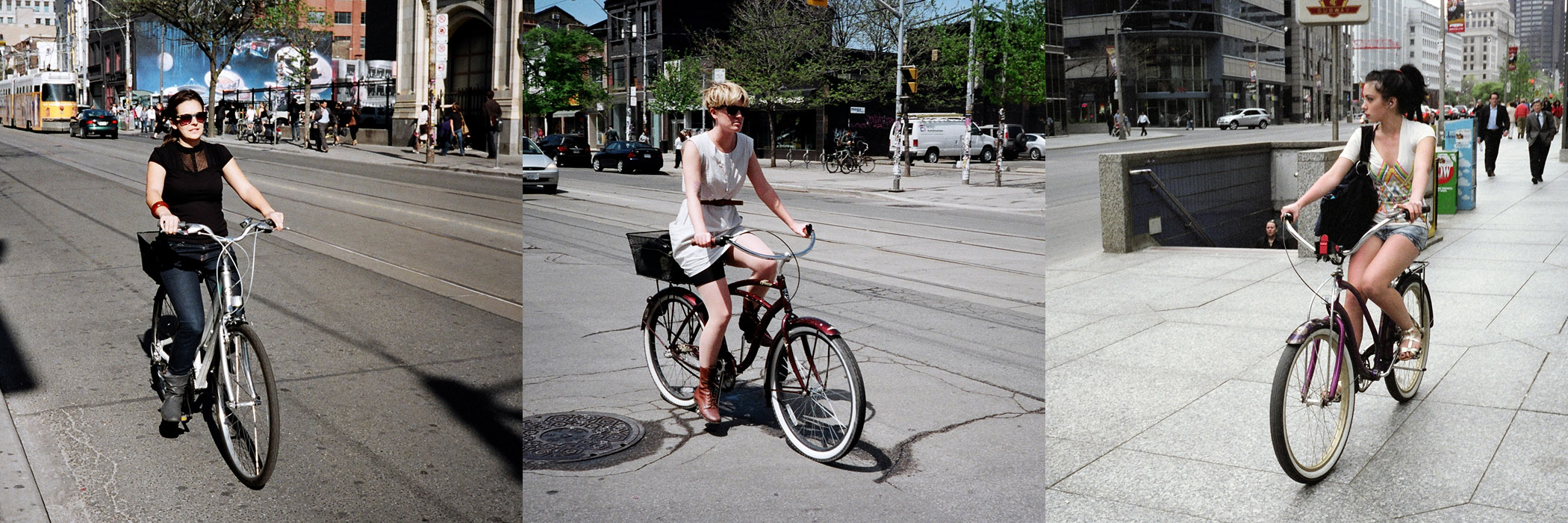
We look damn good on our bikes!
We have more than 70 bike shops in Toronto!
However, I do have one big complaint... and boy-oh-boy is it a doosie!
There are simply not enough cyclists in Toronto.
That's it, that's my complaint.
Some days it's just so lonely. I know there are thousands upon thousands of cyclists around. But, I want to see more... don't you?
Join the discussion in the BikingToronto Forum
Photo via the BikingToronto Flickr Pool
Labels: benefits, biking toronto, BlogTO, complaints
While waiting for the TTC last night at Dufferin and Bloor I watched several cyclists pedal by. Mostly, they were men. And mostly they were wearing cycling tights, and bright yellow cycling jackets, and thick gloves and goggles or glasses.
Video via Let's Go Ride a Bike
How do you dress for winter cycling in Toronto? Share your tips in the BikingToronto Forum
Labels: clothing, commuting, Cycling, Toronto winters, wool
What's stopping teenage girls from riding bikes?
Campaigns to get women cycling seem to focus on how to look good over other concerns. Is this really all girls care about?Posted by Sarah Phillips
Teenage girls don't ride bikes. Or so says the Darlington Media Group, who have set about trying to rectify the problem with a campaign to get young women cycling.
Several years ago, the National Children's Bureau published research that revealed that on average, boys cycle 138 miles a year and girls only 24 miles. This still rings true. Christie Rae, 16, from Newcastle told me: "I do have a bike, but I don't really use it. Only sometimes in the summer when my friends and I cycle round to see each other. I don't know many girls that do, actually."
Darlington's project began with the production of a documentary called Beauty and the Bike, chronicling a trip made by a group of teenage girls to Bremen in Germany, where they met their cycling-loving peers and found out about the joys of the open road. It all sounds slightly twee, but addresses the important issue that girls tend to get to a certain age and it's no longer the done thing to get about by bike.
I have every admiration for such attempt to get women enjoying the numerous benefits of cycling, but what is frustrating is the focus on appearance that is often so integral to said schemes. Aside from the title, BATB, which incidentally has been used for a similar scheme in the past, Darlington's site makes it clear they are keen to address the important issue of remaining fashionable while cycling. But as I recall, it was an overprotective mother that stopped me from spending too much time around the bike sheds in my teenage years, rather than any personal concerns over the way I looked.
Another offender is the site Bike Belles, run by the otherwise excellent charity Sustrans, which encourages women of all ages to take up cycling. One helpful section dedicated to beauty tips provides such gems as: "Use waterproof mascara when it's raining on your bike, and take a powder compact for a quick refresher on arrival." Admittedly, I write as someone who occasionally arrives at the office sporting a minor oil slick on my face, but I sincerely doubt that women are so image conscious that this is what is stopping them. As many a female cyclist will confirm, it is more hassle than it's worth looking attractive while travelling by bike.
Aside from fashion tips, the beauty bikers and belles both voice concerns over the lack of decent cycle lanes and safety issues that make our roads a wholly unappealing prospect. Those two are serious issues that would put inexperienced riders off, and are much more worthy of a campaign to get people, regardless of gender, on their bikes.
Labels: commuting, fashion, Guardian, helmets, infrastructure, safety, UK, women


Labels: bicycle licence, bicycle shaped object, Roncesvalles, safety

Congestion. Downtown Toronto is congested with pollution-emitting vehicles. Yet, pockets of our city also have other forms of congestion, ones we certainly aren't as worried about.
Et tu, Toronto? Traffic a problem Caesar couldn't solve
Options up for consideration at Transportation Futures conference include toll roads monitored by GPS and High Occupancy toll lanes
Anna Mehler Paperny
More than 2,000 years ago, Julius Caesar is said to have gotten so fed up with traffic congestion in ancient Rome that he banned all transport vehicles from the city during the day.
The ensuing nocturnal clatter resulting from this “war on the cart,” as Romans took their commute to the city's narrow nighttime streets, caused mass insomnia and apparently drove Juvenal mad.
Traffic congestion is far from a new problem, or one exclusive to Canada's largest city, whose overcrowded roads, according to the Organization for Economic Co-operation and Development, are costing the Canadian economy $3.3-billion a year. Across North America, individual vehicle trips have grown at a rate far outpacing either population growth or new transportation infrastructure for years. When Toronto Mayor David Miller was first elected in 2003, he made addressing the city's jam-packed roadways a priority – and was the target of a political drubbing for suggesting tolls might be the answer.
This morning in downtown's Metropolitan Hotel, Transport Futures, a non-partisan think-tank, will host a conference to discuss the options open to planners seeking respite from clogged transportation arteries.
This meeting comes on the heels of an Organization for Economic Co-operation and Development report released this week that found congestion in Canada's most populous city costs the country an estimated $3.3-billion annually, and a gauntlet thrown down by the Toronto Board of Trade challenging the city's mayoral candidates to come up with innovative solutions.
Here are some of the options up for consideration.
The Phantom Tollbooth
Nineteenth-century Torontonians had to stop and pay a fee at toll booths on Kingston Road, and although the endangered species of traditional toll booth is almost extinct, it's still in common on bridges.
In the meantime, far more fancy incarnations are taking the “free” out of freeway: Toll gates that could be installed on highways around the Toronto area could charge drivers based on anything from their mileage and driving time to their carbon footprints.
Taking the high-tech route
The congestion-pricing system of the future operates like a souped-up Global Positioning System. It's used in Singapore, the planet's dean of congestion pricing – the island city-state has been fighting clogged roads since 1975. The latest technology involves transponders installed in each vehicle, and charges drivers based on where they drive, what time of day and for how long. Singapore adjusts its prices depending on how crowded roads are, charging more as vehicles' average speed slows to a traffic-clogged crawl and dropping it when space frees up.
London and Stockholm, both cities with a clearly demarcated downtown core, charge drivers each time they enter the inner city. While London has a flat rate, the peninsular Swedish capital changes its fees based on time of day – a far superior, nuanced strategy in targeting congestion, argues Bern Grush. Mr. Grush is chief scientist at Skymeter, a Toronto-based company that researches and manufactures this radio-frequency identification for vehicles.
But a toll strategy that cordons off Toronto's downtown could be a hard political and logistic sell. An ambitious alternative that just received legislative approval in the Netherlands would cover a wide swath – conceivably as much as the entire province of Ontario – so vehicles would be tracked and automatically billed varying prices wherever they went.
High-Occupancy Toll lanes
One more reason to bring your spouse, child or cubicle-buddy along for the ride. Within the next 25 years, Ontario has plans to create 450 kilometres of High-Occupancy Vehicle (HOV) lanes that would be reserved for multi-passenger cars. But many jurisdictions are turning to High-Occupancy Toll lanes and letting solo drivers use them – for a price. Shortly after HOT lanes were set up on a bottleneck stretch of California highway between Orange County and Riverside County, almost half the drivers opted to use the less crowded toll lanes.
Parking
Simple equation: You're less likely to drive your car to work if there's nowhere to put it once you get there. In many jurisdictions there's a growing push to lessen the number of parking spots available, or at least to make them more expensive. Copenhagen has been doing just this – taking away a few parking spots every year in an urban-planning version of musical chairs – for decades, says University of Toronto geography professor Paul Hess, and it seems to be working on the congestion-fighting front. That might not go over so well in Hogtown, however, where business owners and landlords are still required to provide a minimum number of parking spots in their establishments.
Transit and cycling
All those wallet-protecting commuters will have to go somewhere. Although some road space is expected to be freed up when drivers take less clogged routes or make their drive in off-hours, improved transit and cycling infrastructure is a vital part of the equation, says University of Toronto urban planning professor Paul Hess: The city needs to act aggressively to beef up its “skeletal” transit system and make the city safe and attractive for would-be cycling commuters – something it has taken other cities decades to accomplish.
But, Prof. Hess noted, “all successful cities face congestion issues.
“If you don't have congestion, then you're actually in trouble because people aren't moving around wanting to do things.”
Labels: commuting, congestion, Globe and Mail, GPS, parking, tolls, Toronto

Is "bikephopia" a spelling mistake? Or is it a strange mish-mash word meaning a city where it is fear-inducing to bike in? Sort of a bicycle negative of utopia...
From The Toronto Star:
How to conquer bikephopia
A new study suggests women fear cycling in infrastrucutre-poor cities like Toronto. I'm trying to get over it
My bike is going to kill me. That was all I could think about as I rolled the thing out of my apartment and made those initial awkward pedal pushes in my first ride around downtown Toronto.
But gliding along Queen St., with no angry cars honking or getting too close to my wheels, I figured I might actually get home alive. If I could just remember the road rules.
Hand signal directional changes. Turn left on left lanes only, or get off the bike and cross the intersection like a pedestrian. If you're changing lanes near streetcar tracks, approach them at a sharp angle so your tires don't get caught in them. And for God's sake, don't pass cars on their right-hand side at stoplights.
You know the saying that you never forget how to ride a bike? Apparently I had. Or was too scared to remember. Either way, I'm not the only one. Studies from Australia and the U.S. identify me with a demographic researchers insist is key to promoting urban cycling: women.
Jan Garrard, senior public health lecturer at Deakin University in Melbourne, Australia, calls us an "indicator species." Women are more likely than men to avoid cycling because they see it as dangerous. The extent to which women hop on their two-wheelers, or fail to do so, is a good indication of how developed a city's cycling infrastructure is – how safe it is for biking, how accessible and extensive its bike lanes are.
Women in North America largely don't ride bikes. In areas where they do, such as Europe, there are more cyclists on the road overall.
John Pucher, a professor of planning and public policy at Rutgers University in New Jersey, has studied this trend for over 12 years. He found that in Denmark, where 18 per cent of all commutes are by bike, women make up 45 per cent of cyclists on the road. In the Netherlands, where women cyclists are in a slight majority at 55 per cent, cycling takes up nearly a third of all commuting trips.
We Canadians, however, aren't doing so well at a 30 per cent bike share for women, and maybe a 2 per cent commute share for bikes. (The trend is similar in the U.S and Australia.) In Toronto, just 1.7 per cent of the population rode to work in 2006 – just 35 per cent of them female. But we're not the worst city, laughs Pucher. "In Dallas, Texas, 95 per cent of bicyclists are men. Which is disgusting!"
Garrard, meanwhile, explores the psychology behind the numbers – why most women refrain from riding in the first place. She surveyed Melbourne's cycling population by asking what situations kept them from the road.
"For just about every constraint we included in our item list," she says, "women were more likely to say it was a constraint. And these things included traffic conditions, weather, lack of time."
Sounds familiar to me. Though I'd have added fear of my face in the pavement.
A larger number of women also indicated they preferred off-road routes, or paths separate from cars. Last month, Scientific American reported on a Portland, Ore. study that coincides with this, having tracked Portland cycling commutes by GPS. When given the choice, women were more likely to take longer routes to a destination if it meant using a car-separate path.
Which is something cycling advocates in Toronto would argue we don't have enough of. Most are intended for recreational use – not a lot of help if you're trying to get to work, which is largely why I wanted to cycle in the first place.
Pucher points out that the idea isn't to paint the non-cycling majority of women as timid creatures, and that other bike minorities, children and seniors, are also important in gauging a city's bikeability.
"I'm pretty risk-averse myself," he says. "I think anyone who is concerned with safety is going to want some kind of facilities that address those concerns."
There are bike shops in Toronto that try to, by offering women-only programs that teach bicycle repair and construction and traffic laws.
Sherri Byer, co-ordinator at the Community Bicycling Network on Queen St. W., finds she still gets condescended to in unfamiliar cycling shops, even though she's been fixing bikes for eight years.
"I think that's why Wenches with Wrenches is so popular," Byer says of CBN's four-week program, which aims to provide women with a non-competitive learning space. "I kept thinking the market for it would dry up for it, but it's not."
I figured the Sunday sessions for women and transgendered people at Bike Pirates, a cycling co-op on Bloor and Lansdowne, was a good place to start. If I did the work they would supply me with the help, space and tools to build a bike of my own.
And as Lisa McLean, a Sunday volunteer, points out, there's a certain confidence that comes from knowing how your bike works.
That may not stop me from slamming into the open door of a parked car, I think to myself as McLean shows me how to install ball bearings into a stem. But at least I can fix my bike afterwards.
Besides, I can't imagine any of the women working at Bike Pirates fitting into the description of risk-averse or road-shy. With any luck (and a lot more riding), hopefully I will eventually count myself among them.
Labels: commuting, infrastructure, safety, Toronto, Toronto Star, women
An excerpt from the 1958 Disneyland TV Show episode entitled Magic Highway USA.
Labels: video

Labels: 416, cycle chic, Toronto

Labels: Cyclehoop, parking, post and ring

From The McGill Daily:
Walking lifePhoto via Flickr
Max Halparin outlines steps to a healthy city
Overlooking Autoroute 20 on Angrignon one July afternoon, my friend Elizabeth and I decide it would be a good time to dismount our bikes and document our relative danger. As more and more cars rush to the on-ramp leading to the Turcot, the sidewalks and pedestrian lights seem increasingly out of place in the blatantly car-oriented area. But it’s not just highway interchanges surrounded by industrial parks, barren land, and mega-mallas that are ill-suited to bikes and pedestrians. It’s anything designed beyond the human scale. Riding north toward Montreal-Ouest, I wonder how many four-or-more wheelers even noticed the two non-motorists crashing their hurried, gas-guzzling routine.
Any trip beyond the extended McGill bubble reminds me that this is exactly what has defined Canada’s (predominantly sub)urban landscape for the past 60 years. While trekking around Montreal for the better part of the summer and fall conducting a walkability survey of neighbourhoods in nearly every borough, I was struck by how much of the city resembles the stereotypical suburban layout I thought I’d escaped after bidding farewell to the sprawling, monotonous blob that is “outside Toronto.” This would be far less important if the issue was purely one of aesthetics. However, as study after study shows, the way we build our environments can have a significant influence on our health.
Sprawling cities have lead to sprawling waistlines. Our reliance on cars as opposed to our feet or pedals is central to the decreasing rates of exercise – especially that which is incorporated into the daily routine. Automobile emissions in turn affect air quality, leading to smog days in cities and respiratory illnesses in residents.
“It’s probably not that my grandparents went to the gym more, or that our genetic disposition has changed significantly over the past 30 years,” explains University of Washington pediatrics professor Brian Saelens when I ask him why he focuses on understanding the built environment’s effect on health. “If I’m to explain increased rates of obesity and inactivity, the only plausible thing is that we’ve changed our environment.”
...
“A fantastic amount of energy has gone into making the cars happy and providing capacity for more traffic, as if there were no other important issues in the city,” explains architect and urban designer Jan Gehl. Recorded by CKUT-Radio, Gehl’s talk at McGill this past July draws heavily on his experiences making Copenhagen one of the world’s most people-oriented cities, as an example for Montreal to follow.
...
Businesses, however, often claim that if customers can’t park, they won’t shop. Though this line of thinking is often used to derail the installation of bike lanes, data proves these fears illegitimate: other modes of transport increase the number of passersby – to the tune of 8,000 more per year on some Copenhagen streets, Gehl says.
...
Proponents of more liveable cities can find common ground with environmentalists who decry the increased carbon emissions and energy use predicated by suburban living; so can local food advocates fed up with the conversion of arable land to parking lots, buildings, and chemical-addicted lawns. The same is true for teachers and parents who see a correlation between their child’s health and academic performance. “There’s lots of synergies there, but if [the message is] splintered, it’s not going to be nearly as effective,” Saelens notes.
Since the implementation of all this information produced in academic fields still rests outside institutions, connections between public health researchers and other advocates for liveable cities are key. There are encouraging signs that this message is getting out there: the U.S. Centre for Disease Control (CDC) recently published 26 different strategies for preventing childhood obesity suggested by researchers, and the Active Living By Design organization links planners with public health researchers to advocate for healthier living through infrastructural change. Further, Projet Montréal’s success in the mayoral elections suggests the growing popular appeal of people-oriented planning.
At a conference discussing the CDC report, Saelens was asked what change would have the greatest impact over the built environment. His response? “Making gas $10-12 gallon, and the reason isn’t because I don’t want people to drive – there is some utility in it.” With people paying the real price for their behavioural choices, Saelens argues, “then you can have serious conversations about land use and true public transportation.”
LINK
Labels: city planning, Cycling, suburbs, walkable

From The Globe and Mail:
The link between exercise and more brainpowerPhoto via BikingToronto's Flickr Pool
Neuroscientists say parents who want to boost their children's mental performance should encourage kids to hit the road before they hit the books
It is first period at City Park Collegiate Institute in Saskatoon, and the Grade 10 students in Allison Cameron's class are priming their brains for an English assignment.
They strap heart monitors on their wrists and climb on a treadmill or exercise bike for a 20-minute workout. When they're done, they move to their desks and start writing. The students are taking part in a program that aims to help them improve their focus, concentration and, ultimately, their academic performance through regular exercise in class.
The results have been startling: On standardized tests, the children in Movement Matters have dramatically outscored students in classes in which the program wasn't offered.
...
Today, Movement Matters is in its third year and most classes at the school take part. Companies have donated equipment, as has cyclist Greg LeMond, who offered Ms. Cameron six top-of-the-line spinning bikes. A number of schools across the country are interested in setting up something similar.
Fifteen-year-old Benji, whose guardian doesn't want his last name published, goes twice a day to the room with the exercise equipment. He alternates between the bike and treadmill, and usually gets his heart rate up to 140 beats a minute.
“When I first started, I was real tired,” he says. “When I got used to it, it woke me up more. I kind of got better at doing math and reading.”
LINK
Labels: brainpower, children, Cycling, development
 Spotted on Roncesvalles. Increasing visibility and freeing the cyclist of a distinctive "skunk tail" with bright yellow fenders.
Labels: fenders, post and ring, Roncesvalles
City of Cyclists:
Don't worry Toronto, we'll get there.
Labels: Amsterdam, Copenhagen, video
 |
| From Jameson Avenue Impressions |
What gives a bicycle personality? What gives a neighbourhood its charm?
 |
| From Jameson Avenue Impressions |

 |
| From Jameson Avenue Impressions |
 |
| From Jameson Avenue Impressions |
 |
| From Jameson Avenue Impressions |
 |
| From Jameson Avenue Impressions |
 |
| From Jameson Avenue Impressions |
The artists behind the project, Jim Bravo and photographer Kate Young:

For more information visit Mural Routes
Labels: art, Jameson Avenue, Parkdale, potraits, Toronto

The newly-constructed Toronto 2015 Pan American Village will be located at the heart of the Games on an 80-acre site next to the Don River in Toronto’s waterfront district. The Village will be the Games-time home for up to 8,500 athletes and team officials, and will incorporate a full range of conveniences and amenities. Located just east of downtown Toronto, the Village is within 45 minutes of almost all Games venues and less than 25 minutes from the airport. All Village facilities in use during the Parapan American Games will be fully accessible and provide a barrier-free environment.
Construction of supporting infrastructure is already well underway, ensuring that the Pan American Village will be ready for the Games.
* Toronto 2015 will create designs, policies and practices that respect the traditions, cultures, abilities, languages and cuisines of all residents.
* The Village will meet the requirements of the IOC’s Technical Manual on Olympic Village.
* It will meet LEED (Leadership in Energy and Environmental Design) Gold certification standards.
* The secure perimeter of the Village will enclose an 18-acre park featuring running and cycling trails, a recreation/fitness centre, a 400m track and a 50m pool.
* 24-hour service will be available throughout the Village.
* A large transport mall and accreditation services will maximize convenience for athletes and officials.
* The Village Polyclinic will offer a full range of health care services and professionals.
* The Village manager will be a senior member of the Toronto 2015 staff with direct experience in managing a village in a multi-sport games environment.
* The Village will be a safe environment for all residents and visitors.
* After the Games, the Village will become a diverse and sustainable residential and mixed-use development that offers affordable housing on a previously underutilized site.

Labels: Don River, Parapan American Games, Toronto 2015 Pan American Village

Diabetes-prone neighbourhoods selected for research studyFocus on new immigrants living in povertyWith diabetes attacking a disproportionately high number of high-risk groups in pockets around Toronto, a new groundbreaking study hopes residents in North York and Scarborough can help stop the disease in its tracks.
North York's Jane-Finch neighbourhood and Scarborough's Agincourt North area have been chosen to take part in the first program of its kind in Ontario, said Michael Riddell, one of the project's lead researchers and an associate professor at York University's faculty of health.
York's study is based on a report released two years ago from the Institute for Clinical Evaluative Sciences (ICES).
ICES concluded new immigrants living in poverty in Toronto had extremely high rates of diabetes due to a number of factors such as a lack of opportunity for physical activity.
Now, York wants to take that information and go one step further by finding out what it takes to prevent diabetes.
"We have known for quite some time that these neighbourhoods have very high rates of diabetes," said Riddell, a world-renowned diabetes and exercise physiologist.
"When we saw (the ICES report), we thought (residents in high-risk neighbourhoods) must have high rates of pre-diabetes too. We thought 'What can we do to change these neighbourhoods, to make the (incidence) of diabetes not so high?'"
More than two million Canadians have Type 2 diabetes, which is related to obesity and lack of exercise.
The disease can often lead to damage of many of the body's organs. Once contracted, it is rarely reversible.
Riddell, who was diagnosed with Type 1 or juvenile diabetes at the age of 14, said the study will focus on 300 participants of Asian, South Asian, African and African-Caribbean in the Jane-Finch and Agincourt North neighbourhoods whose lifestyle puts them at an extreme risk of developing diabetes.
They will be matched with York University exercise physiologist graduates, who will tailor enjoyable sports programs to their needs. Activities could include games, badminton, basketball, soccer, cultural dances and tai chi.
"We're not just presenting typical walking, jogging, biking (as exercise possibilities). We're trying to be novel (with activities) we think they may like to do," Riddell said.
The opportunities will be offered in small group settings to promote social networking and motivation among participants.
The study, which will last at least six months, will pay for participants' transportation costs.
"We're trying to determine whether we can prevent diabetes in ethnic groups who statistically have much higher rates of the disease," Riddell said.
"Ontario's diabetes rates have already soared past the high levels predicted for 2030. Preventing diabetes now is more crucial than ever."
By bringing fun and free activities to participants in their own neighbourhoods, Riddell hopes the study will achieve two goals.
First, it will show participants the health and social benefits of taking part in activities they enjoy.
"I hope they will embrace it. You're really being offered free trainers," Riddell said.
"Normally, if you want a trainer, you have to shell out a fair amount of money. We're giving it to them for free."
Second, it will prove to governments the importance of investing in exercise to prevent diabetes.
"We expect to reduce diabetes by 60 per cent," Riddell said.
"This is better than any medications, which reduce diabetes by 30 to 50 per cent and medications could be masking (the symptoms). We truly believe exercise or physical activity can reduce diabetes by 60 per cent."
Researchers will work with local public health units, community health centres and culturally based recreation and community centres in Jane-Finch and north Agincourt.
The study will include adults in the targeted ethnic groups between the ages of 40 and 64, the group most at risk of developing Type 2 diabetes.
The Ontario Ministry of Health promotion has provided $425,000 for the study with additional funds coming from the Canadian Diabetes Association.
LINK
Labels: physical activity, Toronto, York University
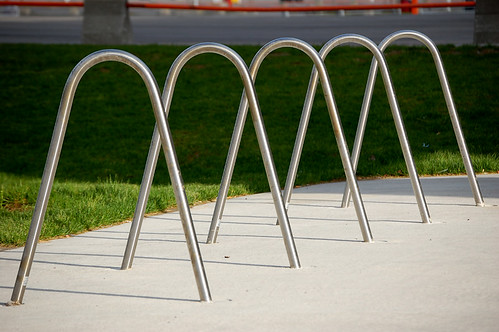
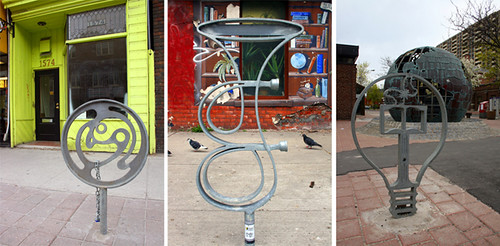
Sure, we're world-famous for our post and ring bike racks... but where else is there to park your bicycle in Toronto? Turns out, you've got plenty of options...
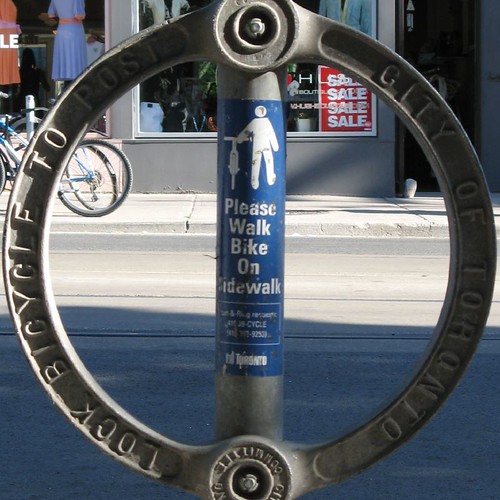
At BMO Field there are arches:
In Parkdale you get glasses:




There's the moving bike rack:


And if you're lucky, your friend will save you a spot:

All photos via Flickr, click on a photo for photographer credit.
Labels: bike racks, infrastructure, post and ring, Toronto

Toronto Riding Far Behind
Mithula Loganathan
Covering 3,600 kilometers, the Tour de France 2010 will be set in 20 stages over a span of 22 days. Drawing in teams from over ten countries world-wide, this bike race exemplifies our strong global bike culture. The British Columbia Bike Race, an epic, seven-day route from Vancouver to Whistler highlights the well-developed bike trails found throughout our westernmost province. While Ottawa lacks an intense race of any sort, Canada’s fourth largest city is home to 822 kilometers of bike lanes. Toronto, Canada’s largest city, can barely count for 250 kilometers (Only 76 of which are not shared with motor vehicles). Though our city prides itself on becoming a world class cycling city, evidence proves otherwise.
Struggling to maneuver through the chaos on Toronto streets, the lack of cyclist-only lanes forces our Toronto bicyclers to share streets with cars, buses, streetcars and trucks. The Toronto Cyclists Union continually strives to change this, as these local cyclists struggle for safety, legitimacy and accessibility of cycling in Toronto.
With over 800 union members and nearly 2000 members on Facebook, both active cyclists and concerned Torontonians are voicing their concerns with safety for bikers.
Competing with big-shot motors not only causes hassle, but the numbers of bicycle-related incidents have steadily increased. As of last year, 1,068 accidents were reported to the Toronto police. The Toronto Transportation Department reported more than 110 cyclist-involved collisions that at occurred major intersections. The death of Toronto native, Darcy Allen Sheppard drew the much needed attention to our city’s bike lane conditions. The 33-year old cyclist was killed on August 31 this year, when a car struck the courier on his way home. Sheppard was the father of three.
In hopes of decreasing these severities, the city of Toronto has partnered with the Ministry of Transportation and the Ontario Trucking Association to create the “Don’t Squeeze” campaign. The DS campaign targets educating cyclists and truck drivers, stressing the importance of driving with ample space behind, in front of and on both sides of one’s vehicle. “Can-Bike” courses have also been made available through Parks, Forestry and Recreation to help Toronto bicyclers understand safety issues.
Adrian Heaps, Toronto city councilor and bike-committee chair argues Toronto bike culture would flourish with the addition and creation of new cycling trails, paths and roads, blaming the number of bike related collision on the lack of facilities.
“You don’t buy a car if there’s no roads. You don’t ride a bike if there’s no infrastructure for it. And we don’t have anywhere near enough” Heaps reasons.
92 kilometers of bike lanes are to be added in 2010, but the city’s goal of doubling the distance of bike routes by 2011 seems hopeful. While bike activists continue to fight for safety and accessibility, the city has taken to educating cyclists in hopes of preventing future accidents. Tour de France may be out of Toronto’s league but hopefully, the current situation can be improved- for the sake of the cyclists, their safety and our city’s reputation.
LINK
Labels: bike lanes, infrastructure, Ottawa, Toronto

Via Curbside Cycle Blog:
Best Bike Store 2009!Wow! Thanks NOW Magazine once again for once again giving us the ‘critics pick’ for Toronto’s best bike store. Curbside is proof that in the case of Toronto bike culture, the citizens are ahead of the government. In the last five years we have romanced some of Toronto’s most unlikely cyclists onto bikes that make them feel safe and fashionable. But fashion is one thing, safety another. The bikes we sell are safer than most, but more than ever, we need to get this city moving with its cycling infrastructure projects.
This year we are throwing all of our weight behind the Toronto Cyclists Union, and to start, we are throwing a Thank You party for all NOW readers. Featuring Juno award winning songster Andrew Rodriguez, male-burlesque performer Corey Swelling (who strips in an amazing ‘bike mechanic’ routine not to be missed!), and many more acts, we want to get all Curbside customers under one roof for a good night of fun. Cover charge is $5 and goes straight into the pocket of the Cyclists Union. So c’mon out!
Labels: Curbside Cycle, Events, NOW Magazine, Toronto Cyclists Union

Old rail corridor opens to new recreational useWest Toronto Railpath Park officially openThe long-awaited West Toronto Railpath Park officially opened with a little pomp and circumstance Friday afternoon, Oct. 30.Davenport Councillor Adam Giambrone hosted a ribbon cutting ceremony along with representatives from the City of Toronto, Scott Torrance Landscape Architect Inc., artist John Dickson and Friends of the West Toronto Railpath group.
"It's already changed the neighbourhood," said nearby resident Kevin Putnam who, undeterred by the rainy weather, attended the festivities at the Wallace Avenue Railpath entrance with his toddler son. "(The park has) quickly become a focal point."
The pedestrian, in-line skating, cycling and skateboard park pathway stretches 2.1 kilometres of land between Cariboo Avenue to the Dundas Street West and Lansdowne Avenue area to the south of Bloor Street West. The city acquired the land in 2001 to develop the multi-use trail for both recreational and commuter purposes. Construction began in June of this year and was completed in September.
"Good things come to those who wait," said Putnam. "My son, he's got a place where he'll be able to ride his bike car-free. For a lot of people it really facilitates a car-free lifestyle."
The new railpath winds its way along the abandoned railway beds that have been out of commission for more than four decades. Because the rail corridor has a substantial width, the railpath will not get in the way of existing train routes. The railpath park's features include a system of wayfaring signs indicating each access point along the route.
"I'm very glad to be here as we inaugurate the West Toronto Railpath... This is a neighbourhood that has a lack of green space. This railpath will add to the green space and community space," said Giambrone. "The community has pushed for this for a long time."
During the construction, the City of Toronto took an inventory of flora and fauna in an effort to protect and enhance the land, which is already a sanctuary for birds, animals, insect and plant life. As part of the project, the city planted a wide variety of trees, shrubs, grasses and perennials.
"It was a day like this that two years ago I collected seeds from plants growing here," said Landscape Architect Scott Torrance. "We started this project in 2006. It takes a real team to complete something like this. One of the most rewarding times for me was when I came this summer. The trail was so well used by parents and children out for an evening stroll."
Toronto artist Dickson created four sculptures, collectively named Frontier, inspired by the changing landscape of the Junction and Railpath Park area. They are constructed of galvanized steel, erected at the south end of the pathway, said Dickson.
"The sculptures' proportions came about through the proportions of the railpath. I wanted a large scale so you could see them from the trains," said Dickson. "I'm looking forward to seeing them incorporate into their environment."
Along the 2,100 metre path, which translates into about 20 walking minutes or five cycling minutes, there is the Wallace Avenue pedestrian foot bridge and the Bloor Street GO Station entrance in addition to several bike stations.
"The neighbourhood is blown away," said Scott Dobson of the Friends of the West Toronto Railpath group. "You hear people talking about this, people are meeting on this trail. It's very incredible."
Labels: ribbon cutting, West Toronto Railpath Park
Hot Chicks On Bikes Montage
Monkey Warfare | MySpace Video
Sorry about the title of the above video. But, that's what it's called on the Monkey Warfare MySpace page.
Labels: Don McKellar, Monkey Warfare, Parkdale, Toronto, Tracy Wright, video
 A trike plus a shopping cart plus milk crates plus buckets and assorted "green" bags and you can take it all with you.
Labels: cargo bike, oddities, Toronto
Protecting an empty skull with her helmet as her brains are secured by a u-lock.


Labels: abandoned bicycle, post and ring, Toronto
 I'd like to see this one parked out front of the Cadillac Lounge in Parkdale.
Labels: Cadillac, one off bike, Toronto Bike Show
The Toronto Mountain Equipment Co-op store is known for many things. The massive climbing wall, the green roof and the overwhelming array of backpacks. Now, they can add an expanded bicycle section that includes a brand of bikes.


Labels: bikes, commuting, cyclocross, mountain biking, mountain equipment co-op, video